InVitro Garden
Tissue Culture Acclimation Substrate
In stock
Couldn't load pickup availability
- Free delivery over - 799 SEK (SE) | 90€ (EU)
- General delivery within 2-7 business days - depending on recipient country
- 14-day return policy
Please note: Product images might differ from the appearance of the actual product received. Size, colour, and form may vary from what is shown.
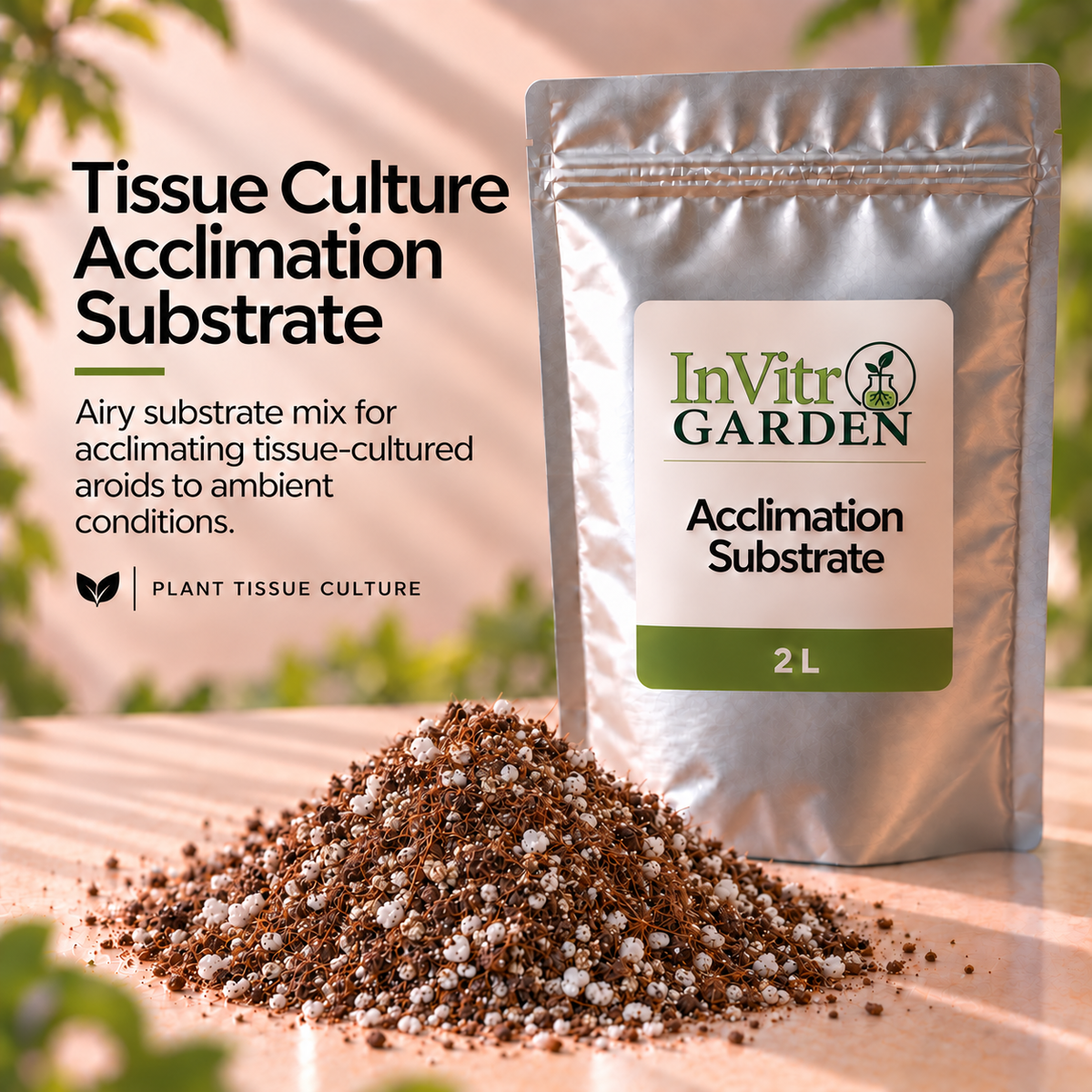
Our Acclimation Substrate is a light, airy substrate mix designed for acclimating tissue-cultured plants after they leave sterile culture, and simultaneously works great as a starting substrate for young plants and cuttings.
The mix combines coco coir, perlite & vermiculite to provide a good balance between moisture retention, drainage and aeration around delicate young roots. This helps plantlets transition gradually from the humid, controlled environment of tissue culture to normal growing conditions.
It is especially suitable for Monstera, Philodendron, Alocasia, Anthurium and other aroids. But also works great for a range of other plants that require a light and airy substrate.
Key features
- Airy structure with good drainage
- Retains moisture without becoming overly compact
- Suitable for delicate newly formed roots
- Designed for the acclimation stage after tissue culture
- Suitable for young plants and cuttings
- Works well with humidity cups or propagation domes
How to Prepare?
Our Acclimation Substrate is supplied dry and expands when hydrated, allowing you to prepare only as much as you need.
Quick Mixing Ratio
For approximately 1 L of prepared substrate, use:
≈ 100 g dry substrate + 250 ml water
The exact amount of water can be adjusted slightly depending on your preferred moisture level.
1. Mix the dry substrate
Before taking out a portion, gently shake or mix the contents of the bag to redistribute the coco coir, perlite and vermiculite evenly.
This is especially important if the bag has been transported or stored for some time, as the different components may settle slightly.
2. Measure the amount you need
Use approximately:
- 100 g dry substrate→ 1 L prepared substrate
- 200 g dry substrate → 2 L prepared substrate
- 500 g dry substrate → 5 L prepared substrate
3. Add water
For every 100 g of dry substrate, start with approximately 250 ml water.
Add the water gradually while mixing rather than pouring it all into one spot. You can slightly reduce or increase the amount depending on the moisture level.
4. Mix thoroughly
Mix until the coco coir, perlite and vermiculite are evenly moistened. Break apart any pieces of coco coir as they absorb water.
5. Check the moisture
Squeeze a handful of substrate gently.
The ideal substrate should be:
- Evenly moist
- Light and airy
- Slightly cohesive when squeezed
- Not dripping or waterlogged
If it still feels too dry, add a small amount of water and mix again.
7. Fill your acclimation cups
Loosely fill your acclimation cup or pot with the prepared substrate. Do not compact the substrate heavily. Keeping the mixture porous allows air to reach the developing root system.
8. Plant your tissue-cultured plantlet
Carefully place the cleaned plantlet into the substrate and gently distribute the substrate around the roots. The plant should be securely supported while the substrate remains loose and aerated.
Complete Mixing Guide
|
Prepared Substrate |
Dry Substrate |
Standard Water |
Adjustable Water Range |
| 1 L |
≈100 g |
250 ml |
225–275 ml |
|
2 L |
≈200 g |
500 ml |
450–550 ml |
|
5 L |
≈500 g |
1.25 L |
1.125–1.375 L |
|
10 L |
≈1 kg |
2.5 L |
2.25–2.75 L |
Moisture Tip
For newly deflasked tissue-culture plants, we recommend starting slightly on the drier end of the range. Additional moisture can always be added later, while an overly saturated substrate can reduce root-zone aeration.
Contents: Perlite + coconut coir + vermiculite
Share

Categories
-
Starter Kits
Complete starter kits and 3-stage sets for aroid tissue culture. Everything you...
-
Tissue Culture Media
Pre-mixed and ready-to-use tissue culture media for aroid Establishment, Multiplication, and Rooting...
-
Hormones & Ingredients
Essential plant growth regulators (PGRs) and ingredients needed to achieve ideal media...
-
Equipment & Supplies
Tissue culture equipment including culture jars, acclimation cups, and accessories for plant...
Blog posts
View all-
How to Tissue Culture Monstera: Step-by-Step Guide
Monstera is one of the most popular plant groups for home tissue culture. Variegated cultivars in particular make tissue culture attractive because a small amount of plant material can potentially...
How to Tissue Culture Monstera: Step-by-Step Guide
Monstera is one of the most popular plant groups for home tissue culture. Variegated cultivars in particular make tissue culture attractive because a small amount of plant material can potentially...
-
Which Plants Can Be Tissue Cultured? 10 Popular...
In theory, a very large number of plant species can be propagated through tissue culture. In practice, some plants are significantly easier and more commonly cultured than others. If you...
Which Plants Can Be Tissue Cultured? 10 Popular...
In theory, a very large number of plant species can be propagated through tissue culture. In practice, some plants are significantly easier and more commonly cultured than others. If you...
-
Plant Tissue Culture Equipment: What You Actual...
Plant tissue culture is often presented as something that requires an expensive laboratory. Professional laboratories certainly use specialized equipment, but small-scale tissue culture can be done with a much simpler setup. The...
Plant Tissue Culture Equipment: What You Actual...
Plant tissue culture is often presented as something that requires an expensive laboratory. Professional laboratories certainly use specialized equipment, but small-scale tissue culture can be done with a much simpler setup. The...