


InVitro Garden
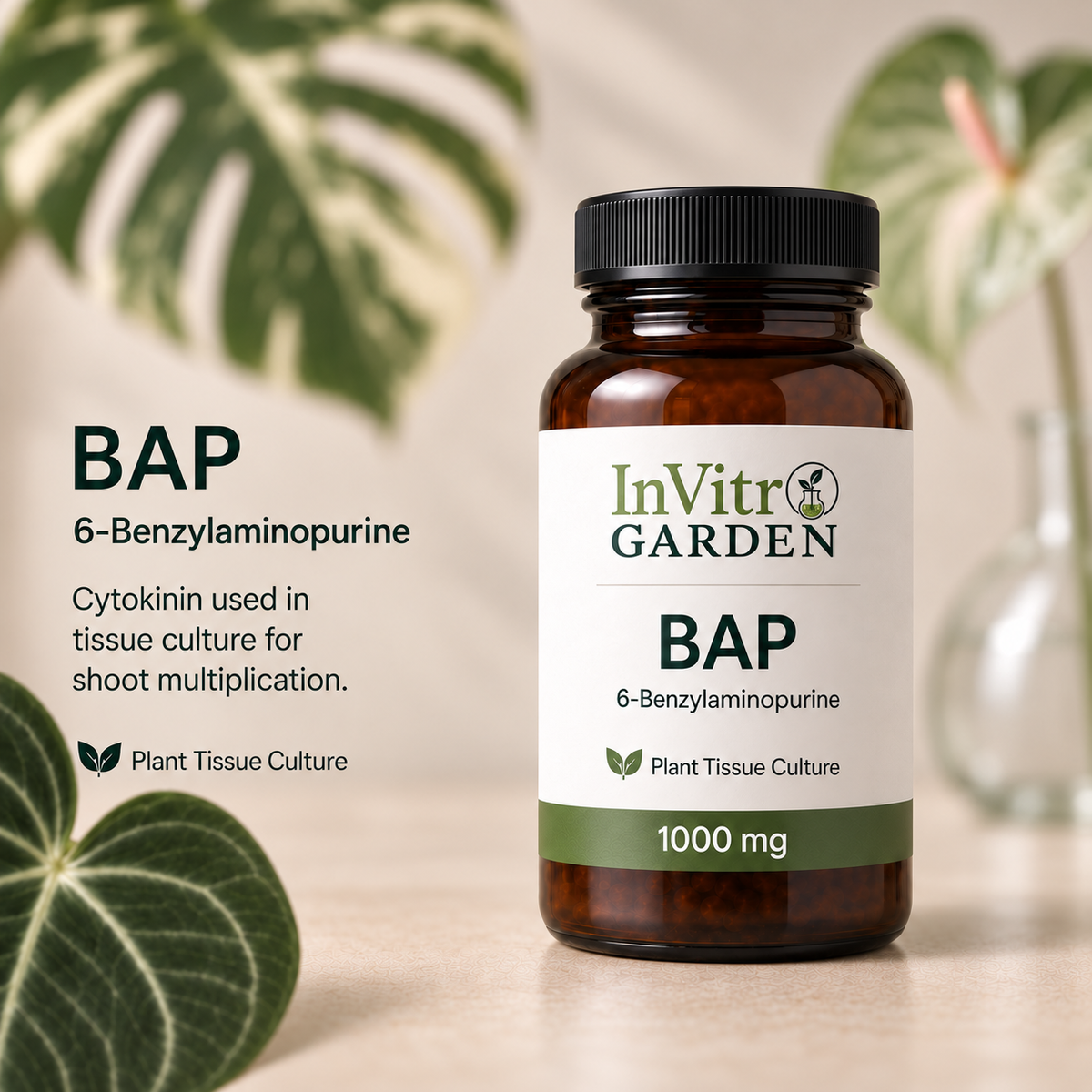
6-Benzylaminopurine (BAP)
6-Benzylaminopurine (BAP)
In stock
Couldn't load pickup availability
- Free delivery over - 799 SEK (SE) | 90€ (EU)
- General delivery within 2-7 business days - depending on recipient country
- 14-day return policy
Please note: Product images might differ from the appearance of the actual product received. Size, colour, and form may vary from what is shown.
BAP — Plant Growth Regulator
6-Benzylaminopurine, commonly known as BAP, is a synthetic cytokinin commonly used in plant tissue culture and plant research for tissue growth and shoot proliferation (multiplication).
BAP is supplied as an individual plant growth regulator for users who want to customise their own culture media formulations or follow fixed protocols. Thus providing great flexibility for the user.
Use in Plant Tissue Culture
BAP may be incorporated into customised plant tissue culture formulations where a cytokinin is required.
Its suitability and concentration depend on factors including:
- Plant species
- Cultivar
- Explant type
- Culture stage
- Other components in the medium
- The protocol being followed
For this reason, users should select concentrations and protocols appropriate to their specific application.
Check out our plant specific protocols →
Pair BAP with
- MS Medium + Vitamins
- Sucrose
- Plant tissue culture agar
And other compatible components according to your chosen protocol.
Suitable for
- Plant tissue culture
- Experimental culture formulations
- Educational use
- Horticultural research
Safety Information
6-Benzylaminopurine (BAP)
CAS: 1214-39-7
WARNING


Hazard statements
H302 – Harmful if swallowed.
H361fd – Suspected of damaging fertility. Suspected of damaging the unborn child.
H410 – Very toxic to aquatic life with long lasting effects.
Precautionary statements
P202 – Do not handle until all safety precautions have been read and understood.
P264 – Wash skin thoroughly after handling.
P273 – Avoid release to the environment.
P280 – Wear protective gloves/protective clothing/eye protection/face protection.
P301+P312 – IF SWALLOWED: Call a POISON CENTER/doctor if you feel unwell.
P308+P313 – IF exposed or concerned: Get medical advice/attention.
Technical Information
| Specification | Information |
|---|---|
| Chemical name | 6-Benzylaminopurine |
| Abbreviation | BAP / 6-BAP |
| CAS No. | 1214-39-7 |
| EC No. | 214-927-5 |
| PGR category | Cytokinin |
| Physical form | Powder |
| Supplier SDS concentration | ≤98% |
Storage
Keep the container tightly closed and store in a dry place. Store at 2-8°C for longer shelf life.
Keep away from unauthorised persons, children and pets.
For plant tissue culture, horticultural, educational and research use only.
Not intended for human or animal consumption.

Categories
-

Starter Kits
Complete starter kits and 3-stage sets for aroid tissue culture. Everything you...
-

Tissue Culture Media
Pre-mixed and ready-to-use tissue culture media for aroid Establishment, Multiplication, and Rooting...
-

Hormones & Ingredients
Essential plant growth regulators (PGRs) and ingredients needed to achieve ideal media...
-

Equipment & Supplies
Tissue culture equipment including culture jars, acclimation cups, and accessories for plant...


Blog posts
View all-

How to Tissue Culture Monstera: Step-by-Step Guide
Monstera is one of the most popular plant groups for home tissue culture. Variegated cultivars in particular make tissue culture attractive because a small amount of plant material can potentially...
How to Tissue Culture Monstera: Step-by-Step Guide
Monstera is one of the most popular plant groups for home tissue culture. Variegated cultivars in particular make tissue culture attractive because a small amount of plant material can potentially...
-

Which Plants Can Be Tissue Cultured? 10 Popular...
In theory, a very large number of plant species can be propagated through tissue culture. In practice, some plants are significantly easier and more commonly cultured than others. If you...
Which Plants Can Be Tissue Cultured? 10 Popular...
In theory, a very large number of plant species can be propagated through tissue culture. In practice, some plants are significantly easier and more commonly cultured than others. If you...
-

Plant Tissue Culture Equipment: What You Actual...
Plant tissue culture is often presented as something that requires an expensive laboratory. Professional laboratories certainly use specialized equipment, but small-scale tissue culture can be done with a much simpler setup. The...
Plant Tissue Culture Equipment: What You Actual...
Plant tissue culture is often presented as something that requires an expensive laboratory. Professional laboratories certainly use specialized equipment, but small-scale tissue culture can be done with a much simpler setup. The...


